📋 Table of Contents
- The Real Question: What Problem Are You Actually Trying to Solve?
- All Four Tools at a Glance
- Alliai — Best for On-Page SEO Automation at Scale
- SEMrush — Best for Keyword Research and Competitive Intelligence
- Surfer SEO — Best for Writing New SEO-Optimised Content
- MarketMuse — Best for Content Strategy and Topical Authority
- Head-to-Head Category Analysis
- Full Feature Comparison Table
- Pricing Comparison
- Which Tool Should You Choose?
- Frequently Asked Questions
- Final Verdict
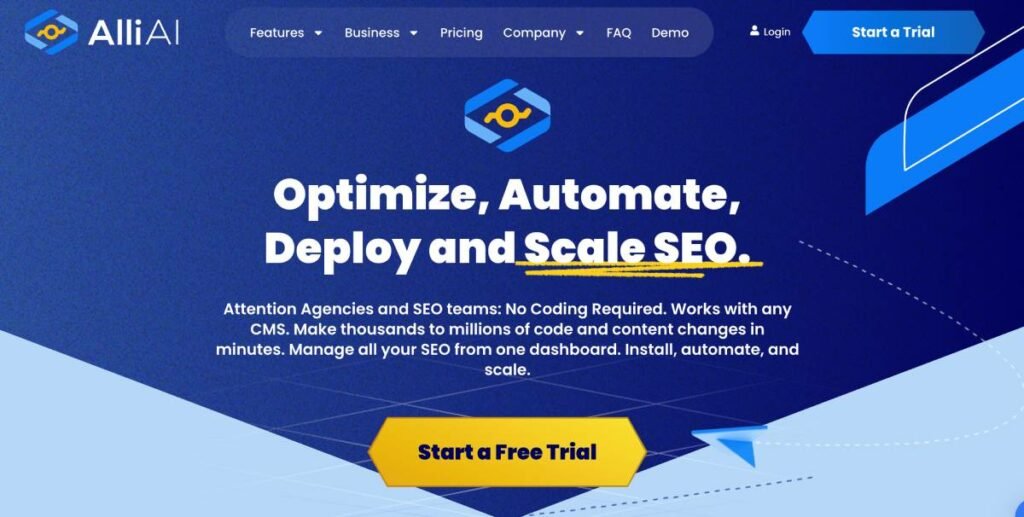
Alliai vs SEMrush vs Surfer SEO vs MarketMuse — a complete 2026 comparison to help you choose the right SEO platform for your specific goals.
SEO tools are not all built to solve the same problem, and buying the wrong one for your specific situation is one of the most expensive mistakes a content business can make. Every tool on this list is genuinely good at something. But what that something is differs significantly between them, and the differences only become obvious once you understand what each platform was actually built to do.
This comparison covers four of the most widely used SEO platforms in 2026: Alliai, SEMrush, Surfer SEO, and MarketMuse. If you run a blog, an affiliate site, a content agency, or an e-commerce store and you are trying to decide where to put your SEO tool budget in 2026, read this all the way through before spending anything.
The Real Question: What Problem Are You Actually Trying to Solve?
Before comparing features, it helps to understand what each tool is fundamentally for. These four platforms are not equivalent alternatives — they solve four different primary problems:
- Alliai — executes on-page SEO changes across your live website at scale, without a developer
- SEMrush — researches keywords, analyses competitors, and monitors backlinks
- Surfer SEO — scores and optimises content as you write it or after it is published
- MarketMuse — plans your content strategy by identifying topic gaps and topical authority opportunities
A common mistake is buying SEMrush or MarketMuse when your actual bottleneck is implementing on-page changes, something those tools are not built to do.
According to Google's SEO Starter Guide, the most impactful on-page factors are title tags, meta descriptions, heading structure, internal linking, and structured data (the exact elements Alliai is built to automate and execute at scale).
Ask yourself: is your SEO problem primarily about finding the right keywords and topics — or about actually implementing SEO changes on your existing pages? That single question should drive your decision more than any feature list.
All Four Tools at a Glance
🤖 Alliai
AI-powered on-page SEO execution. Bulk-edits title tags, meta descriptions, headers, schema, and internal links across your entire site without a developer. Works on any CMS via Chrome extension.
🔍 SEMrush
The most comprehensive SEO research platform available. Deep keyword data, backlink analysis, competitor intelligence, technical site audits, and PPC tools in one platform.
🌊 Surfer SEO
Content optimisation platform that scores your articles against top-ranking pages and tells you exactly what terms, headings, and structure to include. Used primarily for writing new SEO content.
🧠 MarketMuse
Content intelligence platform focused on topic modelling and content gap analysis. Identifies where your site has topical authority and what content you need to build to compete in specific niches.

Alliai's live editor — apply AI-generated on-page changes across hundreds of pages simultaneously without touching your CMS or writing a line of code.
1. Alliai — Best for On-Page SEO Automation at Scale
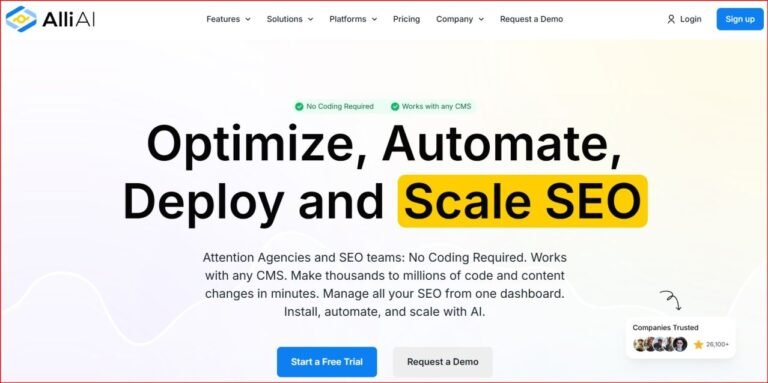
Alliai solves the problem that every other SEO tool on this list ignores: actually making on-page changes to your live website at scale. SEMrush, Surfer, and MarketMuse can tell you what to fix and what to write. Alliai goes one step further, it fixes it.
Through a Chrome browser extension, Alliai lets you edit meta titles, meta descriptions, header tags, alt text, internal links, and schema markup directly on your live pages, and push those changes across your entire site in bulk without touching your CMS backend, editing code, or hiring a developer.
This is particularly powerful for established content sites with hundreds or thousands of existing pages that need to be brought up to current SEO standards. Manually updating title tags and meta descriptions on 800 blog posts would take a content team weeks, Alliai can process the same set of changes in hours.
The A/B testing feature lets you test different title and meta description variants against each other and measure which drives higher click-through rates from Google Search Console data directly.
✓ What Alliai Does Better Than Anyone
- Bulk on-page editing across any CMS — WordPress, Shopify, Wix, Webflow, custom sites
- Live page editor — see changes on the actual rendered page, not a code editor
- Automated internal linking with anchor text optimisation
- Schema markup automation with built-in Google validation
- A/B testing for title tags and meta descriptions
- SEO changes deployed without developer involvement
- Works on sites of any size — from 50-page blogs to 10,000-page e-commerce stores
✗ Where Alliai Has Limits
- No keyword research or backlink analysis — needs SEMrush alongside it for research
- No content writing editor — pairs with Surfer for new content creation
- Chrome-only — no Firefox, Safari, or Edge extension
- Schema features require Growth or Scale plan (not Starter)
- A/B testing requires sufficient traffic to reach statistical significance quickly
2. SEMrush — Best for Keyword Research and Competitive Intelligence
SEMrush is the most feature-comprehensive SEO platform on this list, and also the most expensive at its full capability level. If you want to understand what keywords your competitors rank for, which pages of theirs are driving the most traffic, who is linking to them and from where, and what PPC keywords they are bidding on — SEMrush gives you that intelligence.
The keyword database covers 21.1 billion keywords across 808 million domains, making it the largest data set available in commercial SEO tooling outside of Ahrefs.
The critical thing to understand about SEMrush in this comparison is that it is a research and monitoring tool — not an execution tool. SEMrush will tell you that your competitor ranks on page one for a keyword you are currently on page three for. It will not change your title tag to target that keyword. That step requires a separate tool like Alliai or manual CMS editing.
For teams that have the operational capacity to act on SEMrush's recommendations efficiently, it is indispensable. For solo bloggers who already know their niche well, the research depth may exceed what they can practically action.
✓ SEMrush Strengths
- Most comprehensive keyword database available — 21.1B+ keywords
- Backlink analysis and link-building tools
- Competitor traffic and keyword gap analysis
- Technical site audit covering 130+ on-page issues
- PPC keyword research and ad copy analysis
- Position tracking and SERP monitoring
- Content marketing toolkit with topic research
✗ SEMrush Limitations
- No live page editing — tells you what to fix, not how to fix it at scale
- Most expensive entry point on this list at $129/month
- Overwhelming for beginners — steep learning curve on the full feature set
- No bulk on-page implementation tools
- Many features unavailable on the Pro plan — Guru ($249/month) needed for full capability
3. Surfer SEO — Best for Writing New SEO-Optimised Content
Surfer SEO is the go-to content writing companion for SEO practitioners who produce new articles at volume. Its core product (the Content Editor) analyses the top-ranking pages for a target keyword and reverse-engineers what they have in common: which terms appear, how frequently, how many headings, what word count, how many images.
You write in a live scoring interface that tracks your article's alignment with these factors in real time, showing a score that reflects how well your content mirrors the patterns of already-ranking pages.
The important limitation of Surfer SEO is that it is optimised for the content creation phase, not for optimising existing content at scale.
If you have 500 existing blog posts and you want to update all of them with better titles, meta descriptions, and internal links, Surfer does not give you a mechanism to do this efficiently. You would need to open each post individually in the Content Editor, which at scale is not much faster than manual editing in your CMS.
✓ Surfer SEO Strengths
- NLP-based content scoring against real top-ranking pages
- Live content editor with real-time score feedback
- Content audit feature for optimising existing articles individually
- SERP analyser to understand what actually ranks and why
- Integrates with Jasper AI for AI-assisted content writing workflows
- Keyword research via Keyword Surfer Chrome extension (free)
✗ Surfer SEO Limitations
- No bulk page editing — individual article optimisation only
- No live page editor — works in Surfer's own editor, not on your actual site
- Limited technical SEO coverage — no schema, speed, or heading bulk tools
- Content audit is an add-on, not included in base plans
- No backlink or competitor data — needs SEMrush alongside it for full research
4. MarketMuse — Best for Content Strategy and Topical Authority
MarketMuse is built for strategic content planning rather than tactical execution. Its topic modelling technology analyses the full semantic landscape of any subject — mapping all the related topics, questions, and subtopics that a comprehensive content programme would need to cover to build genuine topical authority in Google's eyes.
For content teams at the strategy stage (deciding which articles to create, in what order, and how to structure a content cluster) MarketMuse gives you a depth of insight that SEMrush's keyword tools do not match.
The limitation is the same as SEMrush's: MarketMuse tells you what to create, not how to make your existing content better at scale. And at $149 per month for the Standard plan, it is the most expensive entry point on this list for a tool that is purely strategic.
Smaller content operations often find that they can replicate most of MarketMuse's content planning outputs through careful manual research in SEMrush or Ahrefs at a lower cost.
✓ MarketMuse Strengths
- Deep topic modelling — maps the full semantic landscape of any subject area
- Content gap analysis — identifies what you are missing relative to competitors
- Content value scoring — prioritises which existing pages have the most upgrade potential
- Authority mapping — shows where your site is strong or weak topically
- Brief generation — creates comprehensive content briefs for writers
✗ MarketMuse Limitations
- Most expensive tool on this list for strategy-only capabilities
- No live page editing, bulk SEO execution, or on-page implementation tools
- No backlink or keyword volume data — strategy without traffic metrics
- Learning curve is significant for non-strategy roles (writers, developers)
- Smaller teams may find its strategic depth exceeds their execution capacity
Head-to-Head Category Analysis
On-page execution is where Alliai has no competition from the other three. SEMrush audits tell you what to fix. Surfer scores suggest improvements. MarketMuse briefs tell writers what to include. None of them publish the changes to your live website.
Alliai is the only platform on this list that can open your live page, generate AI-optimised title tags, meta descriptions, and schema across 500 pages simultaneously, validate them, and push the changes live — without a developer or CMS admin access.
SEMrush is the clear winner on raw keyword and competitive intelligence. Its database covers more keywords, more domains, and more SERP features than any other platform here. Surfer has basic keyword research via the free Keyword Surfer extension.
Alliai does not offer keyword research. MarketMuse provides topic-level analysis but not keyword volume or difficulty data in the traditional SEO sense. If competitive keyword research is the core of your SEO workflow, SEMrush is irreplaceable in this comparison.
For optimising content as you write it, Surfer SEO's live scoring interface is the most practically useful tool on this list. The real-time NLP scoring against actual top-ranking pages gives writers immediate, actionable feedback on what to include and what to expand.
Alliai can update existing pages in bulk but does not offer a content creation editor. MarketMuse generates briefs but does not provide real-time scoring during the writing process. If new content output is your primary SEO activity, Surfer belongs in your workflow.
For understanding where your content programme has topical gaps and where you need to build depth to develop genuine authority in a subject area, MarketMuse's topic modelling is the most sophisticated tool here.
SEMrush has content planning features, but they are keyword-volume driven rather than semantically driven. For enterprise content teams where topical authority is the strategic priority, MarketMuse's depth of analysis is not easily replicated by the others.
None of the other three platforms automate schema markup. SEMrush audits flag missing schema as a technical issue. Surfer and MarketMuse do not address schema at all.
Alliai generates validated JSON-LD schema from page content, applies it across multiple pages in bulk, and checks it against Google's requirements before publishing. For the impact of schema on organic click-through rates, see our detailed guide on Alliai schema markup automation.

Each tool serves a distinct stage of the SEO workflow — strategy, keyword research, content writing, or on-page execution at scale.
Full Feature Comparison Table
| Feature | Alliai | SEMrush | Surfer SEO | MarketMuse |
|---|---|---|---|---|
| Bulk on-page editing | ✓ Core feature | ✗ Not available | ✗ Not available | ✗ Not available |
| Live page editor | ✓ Chrome extension | ✗ No | ✗ No | ✗ No |
| Schema markup automation | ✓ With validation | ⚡ Audit only | ✗ No | ✗ No |
| Internal linking automation | ✓ AI-powered | ✗ No | ⚡ Basic | ✗ No |
| A/B testing (titles/metas) | ✓ Yes | ✗ No | ✗ No | ✗ No |
| Works any CMS | ✓ Any CMS | ⚡ WordPress integration | ⚡ Mainly WordPress | ✗ No CMS integration |
| Keyword research | ✗ Not included | ✓ Industry-leading | ⚡ Basic (free ext.) | ⚡ Topic-level only |
| Backlink analysis | ✗ No | ✓ Yes | ✗ No | ✗ No |
| Content writing editor | ✗ No | ⚡ Basic | ✓ Core feature | ⚡ Brief generation |
| NLP content scoring | ✗ No | ✗ No | ✓ Real-time | ✓ Yes |
| Topic/content gap analysis | ✗ No | ⚡ Keyword-level | ⚡ Limited | ✓ Deep topic modelling |
| Technical site audit | ✓ Yes | ✓ Comprehensive | ⚡ Basic | ✗ No |
| SERP tracking | ✓ Yes | ✓ Yes | ✓ Yes | ✗ No |
| Starting Price (2026) | $99/month | $129/month | $89/month | $149/month |
Pricing Comparison
| Platform | Entry Plan | Mid Tier | Top Tier | Free Option |
|---|---|---|---|---|
| Alliai | $99/mo (Starter) | $199/mo (Growth) | $299/mo (Scale) | 7-day free trial |
| SEMrush | $129/mo (Pro) | $249/mo (Guru) | $499/mo (Business) | 7-day trial |
| Surfer SEO | $89/mo (Essential) | $179/mo (Scale) | $299/mo (Scale AI) | Free Keyword Surfer ext. |
| MarketMuse | Free (limited) | $149/mo (Standard) | $399/mo (Team) | Free (5 queries/month) |
"The cheapest tool is not the one with the lowest price — it is the one that generates the most return per dollar spent. The right frame is cost per ranking improvement achieved, not cost per feature list."
Which Tool Should You Choose?
Match Your Primary SEO Need to the Right Tool
Start Automating Your On-Page SEO Today
Alliai's 7-day free trial gives you full access to bulk editing, schema automation, and the live page editor — no credit card required to start.
Frequently Asked Questions
Yes — and this is actually one of the most effective SEO tool combinations available. SEMrush identifies the keywords you should be targeting and the on-page issues that need fixing. Alliai implements those fixes across your pages in bulk without a developer. The research phase happens in SEMrush; the execution phase happens in Alliai. Together, they close the gap between knowing what to do and actually doing it at scale.
Yes. The two tools serve different stages of the content lifecycle. Surfer SEO is most valuable when writing new content — you create the article in Surfer's editor with real-time scoring feedback. Alliai is most valuable for optimising your existing archive — bulk-updating title tags, adding schema, and fixing internal linking across pages already published. Many content operations use Surfer for new posts and Alliai for existing page maintenance.
No. Alliai is an on-page SEO execution platform, not a keyword research or competitive intelligence tool. It does not have a keyword database, SERP tracking, or backlink analysis. If you need keyword research alongside Alliai, use SEMrush, Ahrefs, or even a free tool like Google Keyword Planner to identify your target keywords, then use Alliai to implement them across your existing pages efficiently.
For most small blogs — under 20,000 monthly visitors — the answer is probably no at the Pro price point. SEMrush's power comes from competitive analysis at scale, and that power is most useful when you have a team large enough to act on the data and competitors close enough in traffic to benchmark against meaningfully. Solo bloggers and small content operations often find that free tools (Google Search Console, Google Keyword Planner, Bing Webmaster Tools) plus Alliai for on-page execution deliver a better ROI than SEMrush at its full price.
For most affiliate bloggers, the highest-ROI SEO investment is optimising the on-page elements of your existing content — not creating more content or doing more keyword research. If you have 50 or more published articles, Alliai's bulk title tag optimisation, FAQ schema application to review posts, and internal linking automation will typically deliver more measurable traffic improvement per dollar spent than adding another month of Surfer SEO or SEMrush. Start with Alliai's free trial, run it across your highest-traffic pages, and measure the CTR impact in Google Search Console before spending further.
Yes. Alliai's Chrome extension works on any live website you can access in your browser — including Shopify stores. This makes it particularly valuable for e-commerce SEO, where manually updating title tags, meta descriptions, and schema across thousands of product pages is one of the most time-consuming and developer-dependent tasks in a store's SEO programme. With Alliai, a Shopify merchant can apply bulk meta optimisations and product schema across an entire catalogue in a single session.
Final Verdict: Which SEO Tool Wins in 2026?
There is no single winner, and that is an honest answer, not a diplomatic one. These four tools are built for four different problems, and the right choice depends entirely on where your specific SEO bottleneck is right now.
Alliai wins if your primary problem is implementing on-page changes at scale. If you have existing content that needs better titles, metas, schema, and internal links (and if you want those changes deployed across your full site without a developer) Alliai is the only tool that does this efficiently.
For bloggers, affiliate marketers, and content agencies with archives to optimise, it is the highest-ROI tool on this list.
SEMrush wins if your primary problem is understanding what keywords to target and what your competitors are doing. The data depth is unmatched and the competitive intelligence tools are genuinely powerful. The limitation is that it tells you what to do rather than doing it.
Surfer SEO wins if your primary problem is writing new content that actually ranks. The live scoring editor is genuinely useful for content creators who want data-driven guidance during the writing process.
MarketMuse wins if your primary problem is content strategy and topical authority mapping. For enterprise content teams with the budget and capacity to execute long-term content programmes, the strategic depth is valuable. For smaller operations, the cost-to-value ratio is harder to justify.
Ready to Automate Your On-Page SEO?
Try Alliai free for 7 days — bulk-edit titles, metas, schema, and internal links across your entire site without writing a line of code.