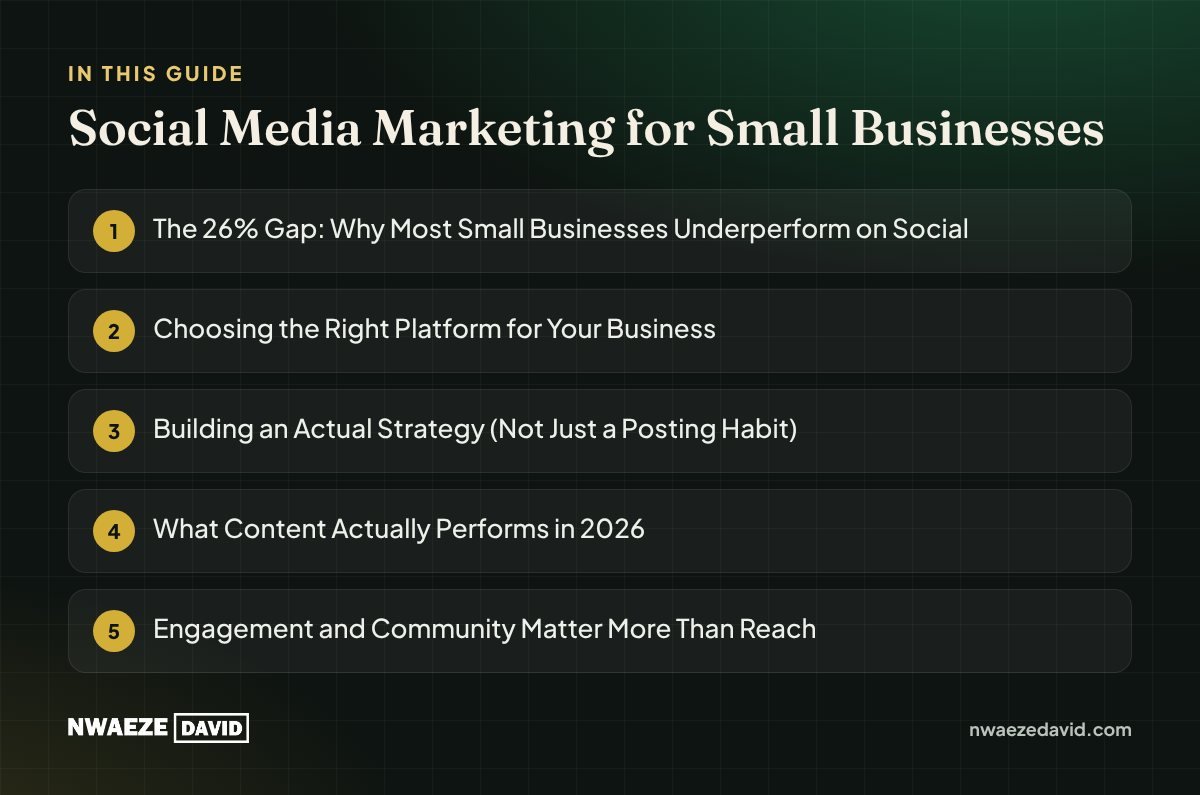
- The 26% Gap: Why Most Small Businesses Underperform on Social
- Choosing the Right Platform for Your Business
- Building an Actual Strategy (Not Just a Posting Habit)
- What Content Actually Performs in 2026
- Engagement and Community Matter More Than Reach
- Measuring What Actually Matters
- Tools to Manage It All
- Frequently Asked Questions
- Final Thoughts
Nearly every small business is on social media in 2026; 77% use it for marketing, customer service, or recruiting. Yet only 26% have an actual documented strategy behind what they post.
That gap is exactly where most of the frustration lives: businesses posting consistently and still seeing nothing to show for it, simply because "posting" and "strategy" are not the same thing.
The 26% Gap: Why Most Small Businesses Underperform on Social
A documented strategy doesn't need to be a 40-page document. It needs to answer four questions clearly: who specifically are you trying to reach, which platform(s) they actually spend time on, what you want them to do as a result of seeing your content, and how you'll know if it's working.
Most businesses skip straight to posting without ever writing down answers to these.
Choosing the Right Platform for Your Business
| Platform | Best For | 2026 Small Business Adoption |
|---|---|---|
| Local businesses targeting adults 25+; product discovery and customer service | 90%+ (up from 76%) | |
| Visual industries, younger demographics | 74% (up from 63%) | |
| B2B and professional services; effectively non-negotiable for this audience | 48% (up from 43%) | |
| TikTok | Younger audiences, fast organic discovery | 33% (up from just 17% in 2023) |
| Home, food, fashion, and lifestyle discovery | Strong niche adoption |
Building an Actual Strategy (Not Just a Posting Habit)
1 Define Who You're Actually Talking To
Be specific; not "small business owners" but "African diaspora entrepreneurs running a side-hustle e-commerce store." Specificity makes every later decision easier.
2 Pick One Clear Goal Per Platform
Awareness, engagement, lead generation, and direct sales each call for a different content approach. Trying to do all four on every post dilutes your message.
3 Build a Realistic, Sustainable Posting Cadence
Consistency at a sustainable pace beats an ambitious schedule abandoned after three weeks. Pick a frequency you can genuinely maintain for a year.
4 Write It Down
Even a one-page document covering your audience, platforms, goals, and posting cadence puts you in the 26% with an actual plan; and statistically, in the group far more likely to succeed.
What Content Actually Performs in 2026
| Format | Performance Signal |
|---|---|
| Short-form video | Now 43% of all content consumed across platforms |
| Reels specifically | 35% higher engagement than standard video posts |
| Image posts | 2.3x more engagement than text-only posts |
| User-generated content / micro-creator partnerships | 92% of consumers trust this more than traditional brand advertising |
For local businesses specifically, a handful of small, locally relevant creators with genuine audience trust consistently outperforms one big-name influencer with broad but shallow reach. A neighbourhood food creator's recommendation reads as a tip from a friend; a celebrity post reads as an ad.
Engagement and Community Matter More Than Reach
Consumers increasingly expect brands to engage meaningfully, not just broadcast; most surveyed users said they specifically want brands to prioritise actually engaging with their audience rather than just posting.
Respond to comments and direct messages within 24 hours where possible; this single habit is one of the most consistently underused, low-cost ways to build the kind of trust that turns casual followers into actual customers.
Measuring What Actually Matters
The average return from social media marketing sits around $5.20 for every $1 spent, and businesses with an active social presence generate roughly twice as many leads as those without, but only if you're tracking the right numbers.
Vanity metrics (likes, follower count) matter far less than engagement rate, click-throughs, and ultimately, leads or sales tied back to specific posts or campaigns.
Tools to Manage It All
As you move beyond manual posting, a proper social media management tool becomes worth the investment, unifying scheduling, engagement, and reporting in one place.
We cover the full landscape in our social media tools comparison, but Sprout Social remains one of the strongest options specifically for small businesses wanting cleaner reporting and a unified inbox as they scale their presence across multiple platforms.
Try Sprout Social Free →FAQs About Social Media Marketing & Strategy
Do small businesses really need a documented social media strategy?
Yes. Businesses with a documented strategy are 313% more likely to report success than those without one, even though only 26% of small businesses currently have one in place.
Which social media platform should a small business start with?
Facebook remains the safest starting point for most local businesses targeting adults 25 and older, given its scale and strength in product discovery and customer service.
B2B and professional service businesses should prioritise LinkedIn instead.
How often should a small business post on social media?
Consistency at a sustainable pace matters more than frequency. A realistic schedule you can maintain for a full year outperforms an ambitious daily schedule abandoned after a few weeks.
What is the average ROI of social media marketing?
The average return is approximately $5.20 for every $1 spent, with businesses maintaining an active social presence generating roughly twice as many leads as those without one.
Final Thoughts
The Bottom Line
The biggest competitive advantage in small business social media marketing right now isn't a clever trend or a viral post; it's simply having a real, written strategy when 74% of your competitors don't.
Define your audience, pick the right platform, post consistently, and engage genuinely. That alone puts you ahead of most of the businesses you're competing with.
Go further
Resources that go with this guide




Written by
Nwaeze David
Nigerian digital entrepreneur, YouTuber and author of more than 20 books on business, money and online income. He writes plain-language guides for entrepreneurs around the world.