Email marketing still delivers one of the highest returns of any marketing channel available to a small business — studies from the Data & Marketing Association consistently put the average ROI around $36 for every $1 spent. But the platform you pick changes that math significantly, especially now that several major providers have quietly slashed their free plans in the past year.
I compared the five tools that come up most often for small businesses in 2026, with real, current pricing and the specific tradeoffs each one doesn't advertise on its homepage.
Quick Picks — Best Tool by Need
Why Email Marketing Still Matters in 2026
Unlike social media reach, your email list is an asset you actually own — no algorithm change can take it away from you overnight. For small businesses specifically, email remains the most direct, lowest-cost way to turn one-time buyers into repeat customers. The platform you choose mainly affects three things: how much you'll pay as your list grows, how sophisticated your automation can get, and whether your emails actually land in the inbox instead of the spam folder.
The 5 Best Email Marketing Tools for Small Business
1. Kit (formerly ConvertKit) — Best Free Plan
⭐ Best for: Creators, bloggers, course sellers, and anyone monetising an audience
Kit expanded its free plan to 10,000 subscribers in late 2025 — roughly 40x more generous than Mailchimp's current free tier. You get unlimited broadcasts, unlimited landing pages and forms, tagging, segmentation, and the ability to sell digital products and subscriptions directly through the platform. The tradeoff is design: Kit intentionally favours plain-text-style emails over heavily designed templates, which is actually a deliverability advantage but won't satisfy anyone wanting a fully branded, image-heavy newsletter.
- Free plan covers up to 10,000 subscribers
- Visual automation builder with tagging and segmentation
- Built-in landing pages and signup forms
- Native digital product and subscription sales
- Most generous free plan in this category
- Predictable pricing as your list grows
- Limited design flexibility (plain-text style by design)
- No built-in CRM
2. MailerLite — Best for Beginners
⭐ Best for: First-time email marketers and budget-conscious small businesses
MailerLite is consistently the easiest tool on this list to actually get started with. The drag-and-drop editor is smooth, automation is included even on the free plan (rare among competitors), and the platform earned G2's "Best Email Deliverability" badge in 2025. Landing pages and a basic website builder come bundled in at every tier, not gated behind an expensive upgrade.
- Automation included on the free plan
- Built-in landing pages and website builder
- Strong, consistently rated email deliverability
- Simple master-list contact model (no confusing duplicate "audiences")
- Easiest learning curve of the five
- Best value paid plan in this roundup
- Free plan reduced to 500 subscribers in 2026
- Automation is simpler than ActiveCampaign's
3. ActiveCampaign — Best for Advanced Automation
⭐ Best for: Businesses with complex customer journeys who need a CRM built in
ActiveCampaign sits at the intersection of email marketing and a genuine CRM. Its visual automation builder supports conditional branches, wait steps, goal tracking, and dozens of trigger types — depth that none of the other tools on this list come close to matching. The native CRM includes sales pipelines and deal tracking, and machine-learning features like predictive sending and churn prediction round out the package. The cost of all that power is a steeper learning curve and no free plan to test it on first.
- Best-in-class visual automation builder with branching logic
- Native CRM with sales pipelines and deal tracking
- Site and event tracking for behaviour-based automation
- Predictive sending and churn-prediction machine learning features
- Unmatched automation depth in this category
- Genuine CRM, not a bolted-on afterthought
- No free plan — must commit before testing fully
- No website builder, steeper learning curve
4. Brevo — Best Value for Larger Lists
⭐ Best for: Businesses with large contact lists but moderate sending volume
Brevo's biggest structural advantage is that it charges by emails sent, not contacts stored — meaning you can hold 100,000 contacts on the free plan without paying a cent, as long as your daily sending volume stays under the cap. It bundles a built-in CRM, transactional email, SMS, and WhatsApp messaging into the same platform, which is unusually broad for the price point. The trade-off shows up in template variety (around 40 designs versus Mailchimp's 100+) and the fact that advanced reporting is locked out of the free plan entirely.
- Unlimited contact storage on every plan, including free
- Built-in CRM, SMS, and WhatsApp messaging
- Automation builder with website tracking triggers
- 12 pre-built automation workflow templates
- Cheapest option here for large, infrequently-emailed lists
- Genuinely multi-channel (email + SMS + WhatsApp) in one tool
- Fewer templates than Mailchimp
- $12/mo extra to remove Brevo branding on lower paid tiers
5. Mailchimp — Best for Integrations
⭐ Best for: Businesses already deep in an app ecosystem that needs to connect to everything
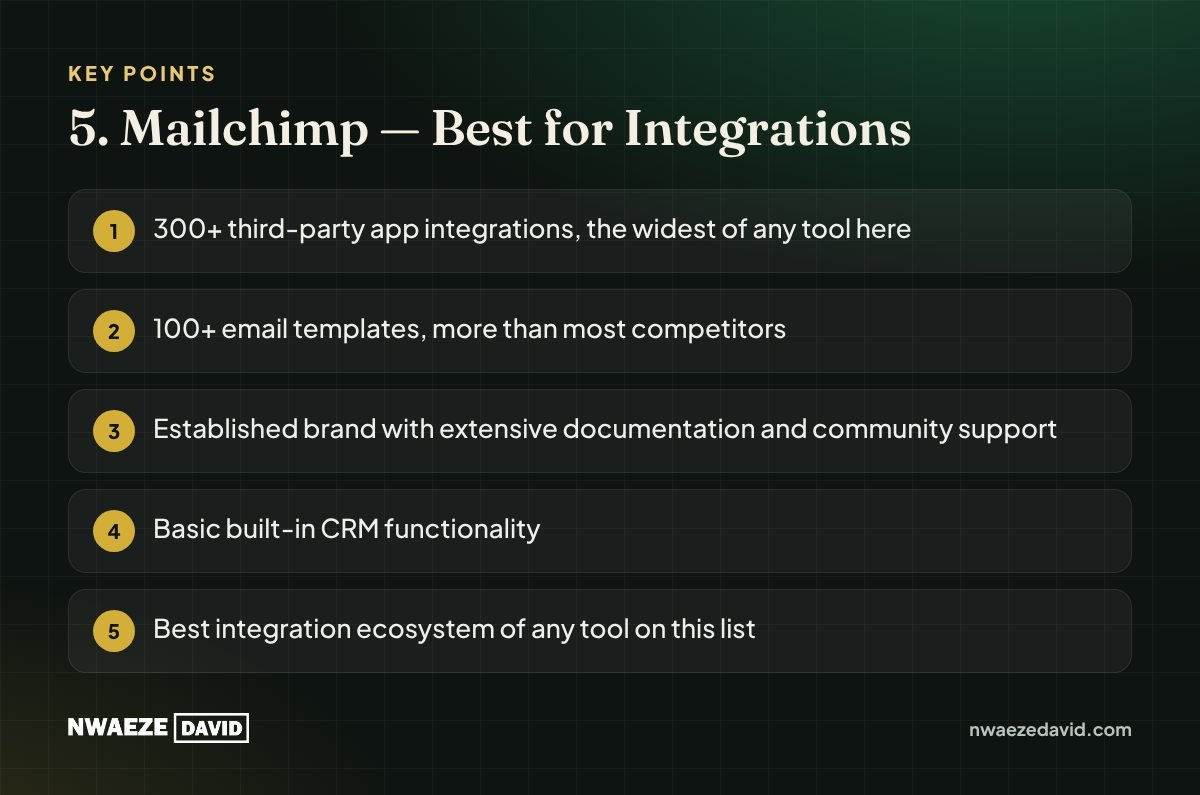
Mailchimp remains the most recognisable name in email marketing, and its 300+ integration ecosystem is genuinely unmatched if your business already runs on a wide stack of connected tools. That said, it is honestly no longer the best pick on most other measures in 2026. Its free plan was cut down to just 250 contacts and 500 sends, automation is increasingly paywalled behind higher tiers, and pricing scales more steeply than MailerLite or Brevo at the same contact count.
- 300+ third-party app integrations, the widest of any tool here
- 100+ email templates, more than most competitors
- Established brand with extensive documentation and community support
- Basic built-in CRM functionality
- Best integration ecosystem of any tool on this list
- Easiest first campaign to send for absolute beginners
- Free plan now barely usable (250 contacts, 500 sends)
- Continues charging for unsubscribed contacts until manually archived
Full Comparison Table
| Tool | Free Plan | Entry Paid Price | Standout Strength |
|---|---|---|---|
| Kit (ConvertKit) | Up to 10,000 subscribers | ~$66/mo (5,000 subs) | Creator monetisation |
| MailerLite | 500 subscribers | $10/mo (1,000 subs) | Ease of use + deliverability |
| ActiveCampaign | None (14-day trial) | ~$15/mo | Automation depth + CRM |
| Brevo | 300 emails/day, unlimited contacts | ~$9/mo (5,000 emails) | Value for large lists |
| Mailchimp | 250 contacts | $13/mo (500 contacts) | Integration ecosystem |
How to Choose the Right One
- If you're a creator, blogger, or course seller → Kit (ConvertKit)
- If you're brand new to email marketing → MailerLite
- If you need complex, behaviour-based automation and a CRM → ActiveCampaign
- If your list is large but you don't email constantly → Brevo
- If you already rely on a wide stack of connected business tools → Mailchimp
Final Verdict
For most small businesses just getting started, Kit's free plan or MailerLite's affordable entry tier will comfortably cover your first 1,000–10,000 subscribers without costing you anything meaningful. Once your business genuinely needs behaviour-based automation and a real sales pipeline tied to your email activity, ActiveCampaign is worth the jump in price and learning curve. Mailchimp still has a place, but only if its integration ecosystem is solving a specific problem for you — its pricing and shrinking free plan no longer make it the default choice it once was.
My Recommendation
Not sure where to start? Begin free with Kit or MailerLite, build your first 1,000 subscribers, and only upgrade to ActiveCampaign or Brevo once you can clearly name the specific feature your current tool can't deliver.
Try Kit Free → Try MailerLite Free → Try ActiveCampaign Free →Frequently Asked Questions
What is the best free email marketing software for small businesses?
Kit (formerly ConvertKit) currently offers the most generous free plan, covering up to 10,000 subscribers with unlimited broadcasts, landing pages, and forms. Brevo is a close second, offering unlimited contact storage on its free plan with a 300 emails/day sending cap.
Is Mailchimp still good for small businesses in 2026?
Mailchimp remains useful if you need its 300+ app integrations, but its free plan was reduced to just 250 contacts and 500 sends, and pricing scales more steeply than MailerLite or Brevo at comparable contact counts. It's no longer the automatic default choice it once was.
Which email marketing tool has the best automation?
ActiveCampaign offers the deepest automation of any tool aimed at small businesses, with over 750 pre-built automation recipes, conditional branching, and a native CRM with lead scoring and deal tracking.
Which email marketing software is cheapest for a large contact list?
Brevo is typically the cheapest option for businesses with large lists but moderate sending frequency, since it charges based on emails sent rather than contacts stored, allowing unlimited contact storage even on its free plan.
Can I switch email marketing tools later without losing my list?
Yes. All major email marketing platforms allow you to export your subscriber list as a CSV file and import it into a new tool. Automations and templates typically need to be manually recreated, so budget some setup time when switching.
Go further
Resources that go with this guide




Written by
Nwaeze David
Nigerian digital entrepreneur, YouTuber and author of more than 20 books on business, money and online income. He writes plain-language guides for entrepreneurs around the world.