📋 Table of Contents
- Why Accounting Software Matters More Than Ever in 2026
- Quick Comparison: All 5 at a Glance
- 1. Xero — Best Overall for UK Limited Companies
- 2. QuickBooks Online — Best for Inventory and Complex VAT
- 3. FreeAgent — Best Value (Free with NatWest/Mettle)
- 4. Sage Accounting — Best for Traditional Accountants
- 5. FreshBooks — Best for Service-Based Solopreneurs
- UK Legal Requirements: MTD, RTI, and Companies House
- Which Software Should You Choose?
- Frequently Asked Questions
The 5 best accounting software options for UK Limited Companies in 2026, ranked and compared.
If you run a Limited Company in the UK, HMRC does not accept excuses, and 2026 has added a new layer of urgency. The old CATO portal used for filing company tax returns was shut down on 31 March 2026, which means software-only filing is now the law for UK businesses. The days of logging into the HMRC website and typing in numbers manually are over.
Add Making Tax Digital (MTD) for VAT, RTI payroll submissions, and the pressure of running a growing business, and choosing the right accounting software stops being a nice-to-have conversation. It becomes one of the most consequential decisions you make as a company director.
I have tested the five top-rated accounting platforms available in the UK right now. I looked at how they handle UK VAT schemes, PAYE payroll integration, bank feeds, and scalability.
Whether you are a one-person contractor or running a digital agency, one of these five is the right fit. And if you are managing tax prep under time pressure, our guide on how to maximise last-minute tax prep with QuickBooks is worth reading alongside this one.
As of 31 March 2026, HMRC's CATO portal has been permanently closed. You must now use compatible software to file your company tax returns. Using a manual process or bridging software workaround is no longer a viable option for most UK Ltd companies. All five platforms on this list are fully compliant.
Why Accounting Software Matters More Than Ever in 2026
There are two legal requirements that dictate your software choice as a UK Limited Company director, and both have teeth.
Making Tax Digital (MTD) for VAT — since 2022, all VAT-registered businesses must keep digital records and submit VAT returns using HMRC-compatible software. You cannot file VAT manually through the HMRC website. Every option on this list is fully MTD-compliant, so you are covered whichever you choose.
RTI (Real Time Information) Payroll — as a Limited Company director, you almost certainly pay yourself a combination of salary and dividends. That salary makes you an employee of your own company, which means you must submit payroll data to HMRC on or before each payday through RTI. Not once a year, every single payday. Your accounting software needs to handle this, or you need to integrate a dedicated payroll tool.
These two requirements alone make a capable, HMRC-approved accounting platform non-negotiable. The question is simply which one fits your business size, budget, and working style.
Quick Comparison: All 5 at a Glance
| Rank | Software | Best For | Starting Price (UK) | MTD Compliant |
|---|---|---|---|---|
| #1 | Xero | Best overall for Ltd companies | £16/mo (Ignite) | ✓ Yes |
| #2 | QuickBooks | Best for inventory and complex VAT | £14/mo | ✓ Yes |
| #3 | FreeAgent | Best value (often free with NatWest/Mettle) | £19/mo* | ✓ Yes |
| #4 | Sage | Best for traditional accountants | £14/mo | ✓ Yes |
| #5 | FreshBooks | Best for service-based solopreneurs | £12/mo | ✓ Yes |
*FreeAgent is available free of charge to business banking customers of NatWest, Royal Bank of Scotland, and Mettle.
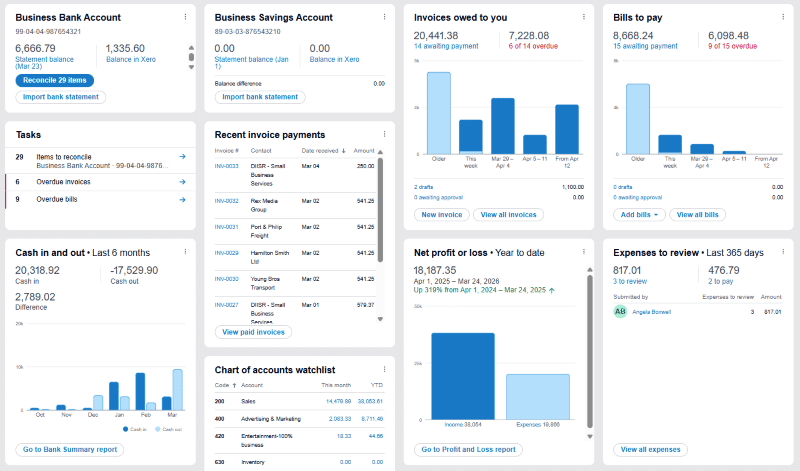
Comparing the UK's top accounting platforms across price, features, and compliance requirements.
1. Xero — Best Overall for UK Limited Companies

Ask ten modern UK accountants what software they recommend, and nine of them will say Xero. It has effectively replaced Sage as the default choice for small and medium-sized businesses in the UK, and for good reason. The bank feed reliability, the built-in payroll module, and the integration ecosystem make it the most complete platform for Ltd companies in 2026. Xero offers a 30-day free trial with no credit card required, making it easy to test before committing.
Why It Wins
- Connects flawlessly with UK banks: Monzo, Starling, Barclays, HSBC, Revolut
- Built-in UK Payroll — handles auto-enrolment pensions (Nest, The People's Pension) and RTI submissions automatically
- Huge app ecosystem: Dext for receipts, Shopify, GoCardless for Direct Debits
- Full MTD compliance across all plans
- Can file micro-entity accounts directly to Companies House
- Best bank feed reliability of any platform tested
Watch Out For
- Multi-currency requires the Comprehensive plan (£47/mo) — steep if you bill in USD or Euros
- Payroll pricing restructured in Sept 2024 — now £1.50 per employee/mo extra on most plans
- No phone support — all support is online via tickets and chat
- Can feel feature-heavy for a very small one-person operation
Xero UK Plan Breakdown (2026)
| Plan | Price/mo | Invoices | Payroll | Multi-Currency |
|---|---|---|---|---|
| Ignite | £16 | Up to 20/mo | Add-on | ✗ |
| Grow | £28 | Unlimited | Add-on (£1.50/employee/mo) | ✗ |
| Comprehensive | £47 | Unlimited | Add-on (£1.50/employee/mo) | ✓ |
| Ultimate | £55 | Unlimited | Add-on (£1/employee/mo) | ✓ |
2. QuickBooks Online — Best for Inventory and Complex VAT

While Xero is the "cool kid," QuickBooks is the heavy lifter. If your Limited Company sells physical goods (e-commerce, manufacturing, wholesale) or you are on a complex VAT scheme such as the Flat Rate Scheme or VAT Margin Scheme, QuickBooks frequently handles the underlying calculations better. The reporting tools are genuinely deeper than Xero's out of the box, and QuickBooks regularly runs discounts of 50% off for the first six months — making it one of the cheapest entry points on this list. Our guide on QuickBooks features that help small businesses succeed during tax season goes deeper on exactly what those tools look like in practice.
Why It Wins
- Stronger native inventory and stock management than Xero
- Deeper, more customisable reporting out of the box
- Better handling of complex VAT schemes (Flat Rate, Margin)
- Frequent 50% off introductory discounts make it cheap to start
- Built-in payroll on paid plans
- Full MTD compliance
Watch Out For
- Interface feels more cluttered than Xero — steeper learning curve
- Charges per additional user — costs rise fast if your team grows
- App ecosystem smaller than Xero's
- Discount pricing is temporary — regular price is higher
3. FreeAgent — Best Value (Free with NatWest or Mettle)

FreeAgent is the industry's best-kept secret. Acquired by the NatWest Group, it is given away free to business banking customers of NatWest, Royal Bank of Scotland, and Mettle. If you bank with any of these, you get a full FreeAgent licence at no cost — saving roughly £228 per year compared to the standalone subscription. It was built with UK contractors and directors in mind, and it shows. The Self Assessment tax return filing for directors is cleaner and more intuitive than anything Xero or QuickBooks offers for that specific use case.
Why It Wins
- Completely free with NatWest, RBS, or Mettle business banking
- Built specifically for UK contractors and Ltd company directors
- Handles Self Assessment for directors better than Xero
- Clean, uncluttered interface — easy for non-accountants
- Full MTD compliance for VAT
- Solid IR35 contract and payroll features for contractors
Watch Out For
- Limited scalability — feels restrictive with 10+ employees
- No large app ecosystem compared to Xero
- Lacks advanced inventory management
- Only free if you use a qualifying NatWest Group bank account
4. Sage Accounting — Best for Traditional Accountants
Sage is the grandfather of UK accounting software. It has been around since 1981, and you will still find it embedded in traditional accountancy firms across the country. If you work with an older-school accountant or a firm that has been managing UK company accounts for decades, there is a real chance they will ask you to use Sage. Its compliance credentials are unmatched — Sage is practically synonymous with HMRC audit trails — and its UK-based phone support is a genuine differentiator at a time when Xero and QuickBooks offer only online assistance.
Why It Wins
- Excellent HMRC VAT compliance and detailed audit trails
- UK-based telephone support — rare in this category
- Preferred by traditional and established accountancy firms
- Reliable and battle-tested for decades
- Full MTD compliance
Watch Out For
- Interface feels dated compared to Xero and QuickBooks
- Less intuitive for business owners doing their own bookkeeping
- Smaller integration ecosystem than the market leaders
- Innovation pace is slower than competitors
5. FreshBooks — Best for Service-Based Solopreneurs

If your Limited Company sells time rather than products — consultants, designers, copywriters, coaches, developers — FreshBooks is a strong contender. It started as an invoicing tool and grew into a full accounting platform, and that origin shows in the quality of its client-facing features. The invoices are the most professionally designed of any platform on this list, the built-in time tracker converts hours directly into billable invoices, and the overall experience is arguably the easiest to pick up for someone who finds accounting genuinely daunting.
Why It Wins
- Best-looking, most professional invoices of any platform here
- Built-in time tracking — hours become invoices automatically
- Easiest learning curve of the five — great for non-accountants
- Client portal for viewing and paying invoices online
- Solid expense tracking and receipt capture
Watch Out For
- Weaker "pure" accounting features — limited balance sheet depth
- Payroll requires a third-party integration
- Not ideal once you hire staff or need complex reporting
- MTD compliance present but less mature than Xero or QuickBooks
All five platforms are fully HMRC-recognised for Making Tax Digital VAT submissions.
UK Legal Requirements Every Ltd Company Director Must Know
Making Tax Digital (MTD) — Non-Negotiable
Since April 2022, every VAT-registered business in the UK must keep digital records and submit VAT returns using HMRC-compatible software.
You cannot type your VAT return into the HMRC website manually. If you are not VAT-registered, MTD for Income Tax is rolling out progressively and will apply to most Ltd companies within the next two years.
All five platforms on this list are fully recognised by HMRC for Making Tax Digital. Whichever you choose, you are covered.
Payroll and RTI Submissions
As a Ltd company director paying yourself a salary, you are technically an employee of your own company. This means you must submit payroll data to HMRC on or before every payday through the RTI system. Here is how each platform handles it:
- Xero — has a fully built-in UK payroll module on Grow, Comprehensive, and Ultimate plans. Handles auto-enrolment pensions and files RTI submissions automatically.
- QuickBooks — also has built-in payroll on paid plans, with RTI filing included.
- FreeAgent — includes payroll for the director as standard.
- Sage — strong payroll with RTI submissions on paid tiers.
- FreshBooks — requires a third-party payroll integration for RTI submissions.
Companies House Filing — Now Software-Only
The HMRC/Companies House joint CATO portal was permanently closed on 31 March 2026. All company tax returns must now be filed through compatible software. This is a significant change for directors who were still using the manual web portal. Xero and FreeAgent both offer Companies House filing features for simpler accounts.
For full statutory accounts, you will likely still need your accountant's specialist software, but your accounting software feeds the data they need. For more context on navigating UK tax compliance, the HMRC official website publishes the current MTD rules and timelines.
Which Software Should You Choose?
Find Your Match
"In 2026, the question is no longer whether you need accounting software. It is which one pays for itself fastest through time saved and penalties avoided."
Ready to Choose Your Accounting Software?
Both Xero and QuickBooks offer free trials. Start with the platform that matches your business type and test it before committing.
Frequently Asked Questions
Practically speaking, yes. Under Making Tax Digital, all VAT-registered businesses must use HMRC-compatible software to submit VAT returns — you cannot file manually through the HMRC website. Additionally, as of 31 March 2026, the CATO portal has been shut down, meaning company tax returns must now be filed through software as well. While technically a non-VAT-registered micro-company could still use spreadsheets with bridging software, it is significantly more effort and more risk than just using Xero or QuickBooks.
The absolute best value is FreeAgent, which is completely free if you open or already have a business bank account with NatWest, Royal Bank of Scotland, or Mettle. If you are not with any of those banks, FreshBooks starts at £12/month and QuickBooks frequently offers 50% off for the first six months, making them the cheapest paid entry points. Always check current QuickBooks discount codes before subscribing, as offers change regularly.
Yes — and your accountant will likely require it. In the past, you handed over a folder of receipts once a year. Today, you and your accountant should both have access to the same live software. You handle day-to-day bookkeeping (invoicing, bank reconciliation, expense logging), and your accountant logs in to handle tax returns, year-end accounts, and adjustments. Most UK accountants will require you to be on Xero or QuickBooks before they take you on as a client.
Most accounting software — including Xero and QuickBooks — handles VAT and payroll submissions automatically. However, filing the final Company Tax Return (CT600) usually still requires your accountant or specialist final accounts software. Xero and FreeAgent do have features to file simpler micro-entity accounts directly to Companies House, but for most standard Ltd companies, your accountant will extract the data from your accounting software and file the CT600 using their own specialist tools.
You can, but the best time to switch is at your company year end. Switching mid-year can create complications with opening balances and duplicate transactions. If you must switch mid-year, use a professional migration service to transfer your data cleanly. Most accountants can advise on the best timing and method for your specific situation.
The CATO (Companies and Tax Online) portal — the joint HMRC/Companies House system used for manual tax return filing — was permanently shut down on 31 March 2026. HMRC cited it as "outdated and no longer aligned with modern digital standards." All company tax returns must now be filed through compatible software. This change makes choosing a proper accounting platform more urgent than ever for Ltd company directors who were still using the manual filing route.