📋 Table of Contents
- Who This Comparison Is For
- Quick Verdict at a Glance
- Deel — Best Overall for Small and Growing Teams
- Oyster HR — Best for Employee Experience and Ethics
- Pricing and Fee Comparison
- Head-to-Head Category Analysis
- Full Feature Comparison Table
- Deel vs Oyster for Diaspora Founders and Global Teams
- Which Platform Should You Choose?
- Frequently Asked Questions
- Final Verdict
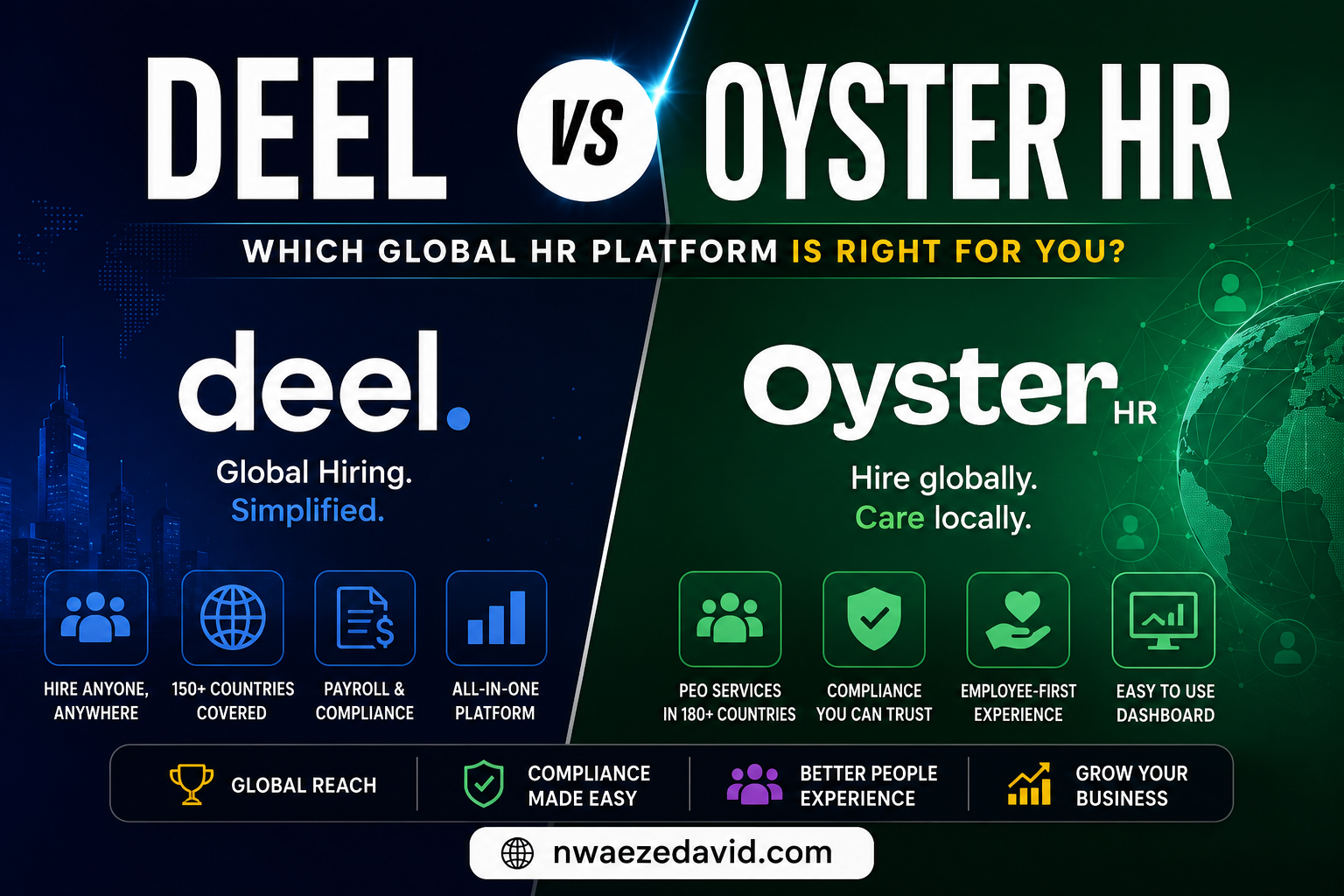
Deel vs Oyster HR — a full 2026 comparison across pricing, country coverage, contractor payouts, and compliance.
You found the right person for the job. A developer in Lagos who ships clean code on time. A video editor in Manila who turns projects around overnight. A marketer in Nairobi who already understands your audience better than anyone you interviewed locally.
Then you try to actually bring them on, and you hit the wall every growing business eventually hits: you do not have a registered company in their country, and setting one up just to employ one person would cost more than that person's entire first year of pay.
This is exactly the problem an Employer of Record, or EOR, exists to solve. An EOR already has the legal entity, tax registration, and compliance groundwork built out in the country your hire lives in. They become that person's legal employer on paper, run payroll, withhold the correct taxes, and administer local benefits, while you keep managing the actual work. No new company to register. No months of legal setup. No risk of a labor authority deciding a year from now that your "contractor" was legally an employee the whole time, back pay and penalties included.
Deel and Oyster HR are the two names that come up most often once you start this search. Both are well-funded, widely used, and legitimate. Both solve the same core problem. And both are the wrong pick for a meaningful share of the people comparing them, because the two platforms are genuinely built around different priorities, not just different logos.
This comparison breaks down pricing, country coverage, contractor payouts, support, and compliance for both, so you know which one actually fits how you are hiring right now.
Who This Comparison Is For
This article is written for:
- Solopreneurs and small agency owners hiring their first team member outside their own country
- E-commerce and content business owners who need a VA, editor, or support agent based somewhere with a lower cost of living
- SaaS founders building a distributed team without opening a foreign subsidiary just to make one hire
- Diaspora entrepreneurs based in the UK, US, or Canada who want to hire back home in Nigeria, Kenya, Ghana, or elsewhere in Africa, legally and without guesswork
- Africa-based founders whose business has grown enough to need talent outside their own country, and who want the paperwork handled correctly the first time
The market backing this is not small. The global EOR industry is on track to reach roughly $8.4 billion by the end of 2026, and 82% of companies now offer some form of remote work. Hiring across borders has stopped being an exotic move for venture-funded startups. It is now a normal step for any business that has run out of the right people nearby.
If you want the fuller picture before narrowing down, our global payroll providers roundup and payroll provider comparison cover more ground across more platforms. This piece goes deep on one specific decision: Deel or Oyster, once those are the two names you have actually narrowed it down to.
Quick Verdict at a Glance

Deel's dashboard consolidates EOR employees, contractors, and payroll in one view.
Deel — Built for Teams That Want to Scale Without Adding More Tools
Deel was founded in 2019 by Alex Bouaziz and Shuo Wang around a single idea: hiring across borders is legally complicated, but it does not have to be operationally complicated. Six years on, Deel is used by more than 20,000 companies to hire, pay, and manage distributed teams, and it holds the strongest review volume and rating of any platform in this category.
What started as a contractor payment tool has grown into what Deel now calls a full workforce platform. Alongside EOR coverage in 150 to 160+ countries, with Deel directly owning roughly 250 legal entities across 100+ of them rather than routing everything through outside partners, it now handles IT and device management, immigration case support, performance reviews, and a set of AI agents that answer HR and compliance questions instantly instead of sitting in a support queue.
For most small and mid-sized businesses comparing EOR platforms in 2026, Deel is the one to beat on price, breadth of features, and payment flexibility, especially if any part of your team is paid outside the traditional banking system.
✓ Deel Pros
- Cheaper EOR pricing than Oyster ($599 vs $699/employee/month)
- Free core HRIS for teams under 200 people
- 15+ contractor payout methods, including Payoneer, Wise, and crypto
- 120+ native integrations, including Xero and QuickBooks
- 24/7 support across phone, video, WhatsApp, and Slack
- AI compliance assistant flags worker misclassification risk automatically
- Owns 250+ entities directly rather than relying only on partners
✗ Deel Cons
- Named account manager is an Enterprise-tier feature, not standard
- Some reviewers note refundable deposits on EOR hires that are not listed on the public pricing page
- Help documentation leans toward contractor-side questions over company admin questions
- The sheer number of products (EOR, IT, immigration, performance) can feel like more platform than a 2-person team needs
Oyster HR — Built for Teams That Prioritize Employee Experience
Oyster HR starts from a different premise than Deel. Where Deel positions itself as infrastructure, Oyster positions itself as the people-first alternative, and it backs that up with substance rather than just messaging. Oyster is the only B Corp-certified global employment platform in the category, meaning it has been independently audited on how it treats workers and runs its business, beyond just uptime and feature counts.
Oyster markets coverage in 180+ countries, wider than Deel's claimed reach, though some of that footprint runs through local partner networks rather than wholly owned entities, worth confirming directly for whichever country matters most to you. Every Oyster account gets a named Hiring Success Manager as standard, a role Deel reserves for its Enterprise tier.
In G2's Spring 2026 rankings, Oyster earned Leader status across Employer of Record, Global Employment Platforms, Multi-Country Payroll, and HR Compliance, plus first-place rankings for Easiest Admin and Best Estimated ROI. It costs $100 more per employee per month than Deel, and its own reviewers are genuinely split on whether that gap is worth it.
✓ Oyster HR Pros
- Only B Corp-certified platform in the EOR category
- Named Hiring Success Manager included on every plan, not just Enterprise
- Transparent, all-inclusive pricing with no separate onboarding or offboarding fees
- G2 Spring 2026 Leader across four separate categories
- Oyster Academy gives hires access to upskilling and career development resources
- Employment liability insurance included, covering legal costs if a dispute arises
✗ Oyster HR Cons
- $100/employee/month more expensive than Deel for the core EOR product
- Fewer native integrations (around 20, including BambooHR and Greenhouse) than Deel's 120+
- Some reviewers report slower, more ticket-based support and time-zone delays
- Contractor payout methods are more limited than Deel's
- 180+ country claim includes markets served through partners, not all owned entities
Pricing and Fee Comparison
On paper, the two platforms look close. In practice, the gap widens once you look past the headline EOR fee.
Deel vs Oyster HR — Line-by-Line Pricing (2026)
The platform fee is only one line in the total cost of hiring internationally. Salary, employer payroll taxes, and statutory benefits, which run anywhere from 13% to 40% on top of gross pay depending on the country, almost always dwarf the platform fee itself. Before you commit to either platform, run your specific target countries through their cost calculators rather than comparing the $599 vs $699 headline numbers alone.
Head-to-Head Category Analysis
Deel's EOR fee is $100 cheaper per employee per month than Oyster's, and that gap holds across contractor management too. Oyster's counter-argument is that its $699 is genuinely all-inclusive, with no separate charges for setup, onboarding, or offboarding that can appear as line items elsewhere. For a single hire, that transparency is a smaller factor than it sounds; for a team of ten, the $100/month gap is $12,000 a year before you have added a single extra feature.
Oyster markets 180+ countries against Deel's 150-160+. In practice, both numbers include a mix of wholly-owned entities and local partner networks, and the honest answer is that neither platform is uniformly strongest everywhere. Deel emphasises that it owns roughly 250 entities directly across 100+ countries, which tends to mean faster, more predictable onboarding in its owned markets. If you are hiring in a frontier market for either platform, ask directly whether coverage there is owned or partner-based before you sign anything.
This is where Deel separates itself for an audience paying or getting paid across African and diaspora corridors specifically. Deel supports 15+ payout methods, including standard bank transfer, PayPal, Payoneer, Wise, Mercury, Brex, and crypto. Oyster's contractor payment options are narrower by comparison. If your hire would rather be paid into Payoneer or a stablecoin wallet than wait on a slow SWIFT transfer, Deel is built for that reality in a way Oyster currently is not.
Deel connects to 120+ tools, including Xero and QuickBooks, which matters directly if you are already using either platform for your books (see our full Xero review and QuickBooks review for more on each). Oyster's integration library is smaller, roughly 20 tools including BambooHR, Greenhouse, and Zapier, which covers common HR and recruiting stacks but leaves more manual reconciliation for anything outside that list.
Deel advertises 24/7 support across phone, video, WhatsApp, and Slack, plus an AI assistant for instant answers, but a named account manager is reserved for Enterprise customers. Oyster gives every account a named Hiring Success Manager from day one, though independent reviews also mention slower response times across time zones and a more ticket-based process for some requests. Neither platform has a spotless record here. If having one specific human to call matters more to you than 24/7 channel breadth, that tips toward Oyster.
Oyster's B Corp certification is not a marketing badge, it means an independent body has reviewed how the company treats its own workers and the hires placed through its platform. Combine that with Oyster Academy's upskilling resources, built-in employment liability insurance, and G2's Spring 2026 Leader recognition across HR Compliance and Multi-Country Payroll, and Oyster has a genuinely stronger claim here than Deel, which competes primarily on scale and automation rather than on employee experience.

Oyster HR's onboarding is built around guided compliance and a named point of contact for every account.
Full Feature Comparison Table
| Feature | Deel | Oyster HR |
|---|---|---|
| EOR fee | $599/employee/mo | $699/employee/mo |
| Contractor management | Free–$49/mo | $29/mo |
| G2 rating | 4.7/5 | 4.4/5 |
| Country coverage | 150-160+ | 180+ (partner-inclusive) |
| Owned legal entities | ✓ ~250 across 100+ countries | ⚡ Mixed owned/partner model |
| Free core HRIS | ✓ Under 200 employees | ⚡ Limited free tier |
| Contractor payout methods | ✓ 15+, incl. Payoneer, Wise, crypto | ✗ Narrower selection |
| Native integrations | 120+, incl. Xero, QuickBooks | ~20, incl. BambooHR, Greenhouse |
| Named account manager | ⚡ Enterprise tier only | ✓ Standard on every plan |
| 24/7 multi-channel support | ✓ Phone, video, WhatsApp, Slack | ⚡ Business hours, ticket-based |
| B Corp certified | ✗ No | ✓ Yes — only EOR platform with this |
| Employment liability insurance | ✗ Not a standard feature | ✓ Included |
| AI compliance assistant | ✓ Yes, with misclassification checks | ✗ Not currently offered |
| US PEO option | Included in broader plans | $114/employee/mo |
Deel vs Oyster HR for Diaspora Founders and Global Teams
For founders based in Nigeria, Ghana, or Kenya hiring outside their own country, or for diaspora founders in the UK, US, or Canada hiring back home or elsewhere globally, the standard comparison above misses a few things that matter more than they look at first glance.
Hiring Your First International Team Member Without Opening a Foreign Entity
This is the exact problem both platforms exist to solve, and it applies whichever direction you are hiring in. A Lagos-based founder scaling past their local team into Kenya or the Philippines faces the identical legal question a UK-based diaspora founder faces when hiring a developer back in Nigeria: who is the legal employer, and who is responsible for the tax filing? Both Deel and Oyster answer that question the same way, they take on the legal employment relationship so you do not have to register a company somewhere just to pay one person correctly.
Getting Paid and Paying Contractors Across Borders
This is where the platform choice actually changes outcomes for this audience specifically. Traditional bank wires into or out of Nigeria, Kenya, or Ghana are slow, carry hidden FX markups, and sometimes get held up entirely by compliance checks on the receiving end.
Deel's support for Payoneer, Wise, and crypto payouts sidesteps a meaningful share of that friction, letting a contractor in Lagos or Nairobi receive funds through a rail that is already familiar and fast rather than waiting three to five business days for a SWIFT transfer to clear.
If you are a diaspora founder hiring your first employee back home:
(1) Run the total cost of employment for that specific country through both platforms' calculators before comparing headline prices;
(2) Ask directly whether your target country is served through an owned entity or a local partner on each platform;
(3) If your hire will want Payoneer, Wise, or crypto rather than a bank wire, weight that heavily toward Deel;
(4) If having one named person to call matters more to you than 24/7 chat access, weight that toward Oyster.
Which Platform Should You Choose?
Find the Right Platform for Your Situation
Ready to Hire Your First International Team Member?
Both platforms offer a free demo before you commit. Start with Deel for the lower price and wider payout options, or Oyster if a guided, people-first process matters more to you.
Frequently Asked Questions
Setting up your own entity means registering a company, opening a local bank account, and managing tax filings and compliance yourself in that country, a process that typically takes months and costs thousands of dollars before you have hired anyone (our LLC formation services guide breaks down what that process actually looks like in the US specifically). An EOR already has that entity and infrastructure in place. You pay a monthly fee per employee instead, and the EOR handles the legal employment relationship, payroll, and compliance on your behalf. For one or two hires in a country, an EOR is almost always cheaper and faster. Past 20-30 employees in a single country, opening your own entity can become the more cost-effective option, which is part of why some businesses eventually move off Deel or Oyster once they have scaled far enough in one market.
Not necessarily. If the person is genuinely an independent contractor, both Deel and Oyster offer contractor management products (Deel from free to $49/month, Oyster at $29/month per contractor) that are cheaper than full EOR employment and handle contracts, invoicing, and payment without the misclassification exposure of just wiring money yourself. The distinction that matters legally is control: if you set their hours, provide their equipment, and direct their day-to-day work the way you would an employee, most countries will consider that person an employee regardless of what the contract calls them, and that is exactly the risk an EOR is built to remove.
Deel is cheaper on the headline numbers, $599 versus $699 per employee per month for EOR, and its contractor management starts free. Oyster's counter-argument is that its $699 is genuinely all-inclusive with no separate setup, onboarding, or offboarding charges. For a single hire the difference is a few hundred dollars a year, small enough that other factors should probably decide it. For a team of ten or more, Deel's pricing advantage compounds into a meaningful five-figure difference annually.
Through Deel, yes. Deel supports 15+ payout methods for contractors, including Payoneer, Wise, standard bank transfer, PayPal, Mercury, Brex, and several cryptocurrency options. Oyster's contractor payment options are narrower and lean more heavily on standard bank transfers. If your hire in Lagos, Nairobi, or Manila would rather receive funds through a payment rail they already use daily than wait on an international wire, that is a meaningful point in Deel's favor.
Both platforms advertise onboarding in a matter of days rather than weeks once paperwork is submitted, typically 48 hours to a week for straightforward markets where the platform holds a direct entity. Timelines stretch when hiring in a country served through a local partner rather than an owned entity on either platform, so it is worth asking directly about your specific target country before you assume a universal timeline.
Both platforms list coverage across major African markets including Nigeria, Kenya, Ghana, and South Africa, though exact depth varies by country and neither publishes a full owned-versus-partner breakdown by market. Deel's broader payout method support (Payoneer, Wise, crypto) tends to matter more in practice for African hires than the raw country-count claim from either side. Confirm your specific country directly with both platforms' sales teams before signing, since coverage details change faster than review articles can track them.
Final Verdict: Deel vs Oyster HR in 2026
Both platforms are genuinely capable of doing what they were built to do. The decision comes down to what you are actually optimizing for.
Deel is the stronger choice for most people reading this, specifically solopreneurs, agencies, and SaaS founders hiring their first few international team members who want the lowest price, the widest set of payout options, and integrations that plug straight into books already run through Xero or QuickBooks.
Oyster HR is the stronger choice if employee experience and accountability are part of your decision, not just your cost per hire. Its B Corp certification, named account manager on every plan, and G2 Spring 2026 Leader recognition across HR Compliance make it a genuinely different kind of platform, not simply a more expensive version of Deel.
For diaspora founders and African-based entrepreneurs specifically, the practical answer in 2026 is to start with Deel for the price and the payout flexibility that actually matches how your team wants to get paid, and revisit Oyster once headcount or the specific country you are hiring in makes its strengths worth the extra $100 a month.
If you have already scaled past 50 employees and payroll consolidation across many countries has become the real headache, Deel and Oyster are not really built for that stage. Our full Papaya Global review covers the enterprise-focused alternative in more depth.
Start Hiring Internationally Today
Both platforms offer a free demo before you commit to anything. Start with Deel for price and payout flexibility, or Oyster HR for a more guided, people-first process.